Sector
Mobility / Autonomous Systems
Role
UX Designer · End-to-End Experience Design · Interaction Design
Team
UX Designer · Product Manager · AI Engineer (Bosch Engineering)· Engineering
Duration
2 months · 2024
Overview
Neural Automated Labeling (NAL) is a commercial SaaS platform by Bosch Engineering that provides fully automated 3D data labeling for autonomous driving and advanced driver assistance systems. Building AI for self-driving vehicles requires massive amounts of precisely labeled 3D data, but manual labeling is slow, expensive, and impossible to scale at the volumes modern AI development demands.
NAL's AI engine addresses this directly, reducing labeling costs significantly and cutting turnaround time to days. I was brought in as a UX partner to design the end-to-end interface, making that powerful capability accessible to external customers. Read more about NAL →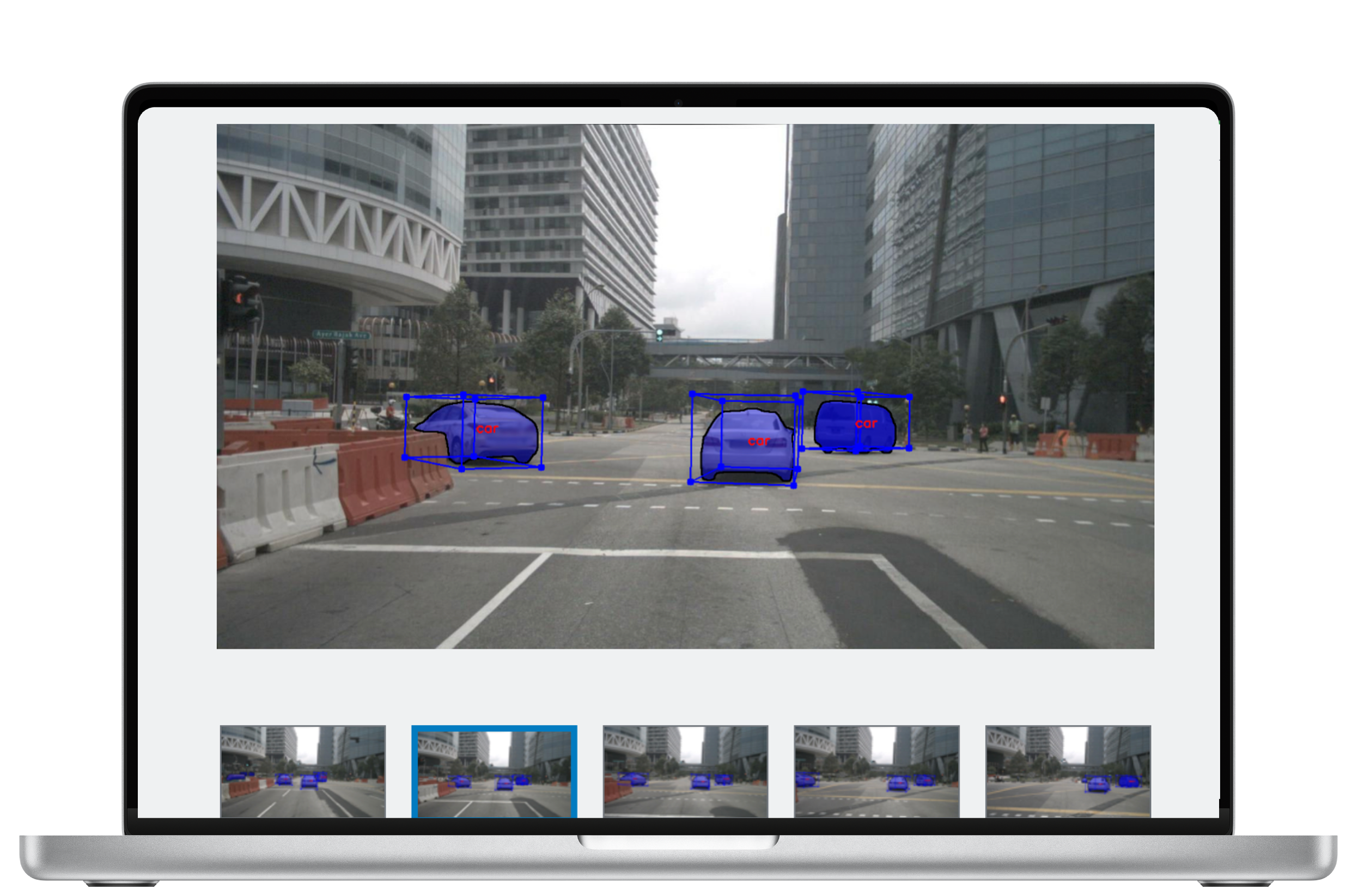
NAL's AI engine addresses this directly, reducing labeling costs significantly and cutting turnaround time to days. I was brought in as a UX partner to design the end-to-end interface, making that powerful capability accessible to external customers. Read more about NAL →
Problem Context
The AI engine was technically impressive. But without a usable interface, customers couldn't access that capability efficiently. The Bosch Engineering team had deep AI and engineering expertise but a clear UX gap — no structured user flows, no onboarding experience, and no intuitive way for customers to submit jobs, monitor progress, or interpret results.
My role was to bridge that gap.
My role was to bridge that gap.
Design Approach
This was a fast-moving innovation project with no formal research phase. My primary input was the AI engineer, who had deep domain knowledge of how the system worked and what customers needed to accomplish.
Working closely with him, I mapped and designed the full end-to-end flow across three stages:
*Screenshots are not publicly available due to commercial confidentiality. Work samples available on request.
Working closely with him, I mapped and designed the full end-to-end flow across three stages:
- Onboarding NAL uses an invitation-based access model. Admins invite users directly from the system's user management page. Invited users receive an email and complete their account setup via Bosch's identity platform. Once set up, they have immediate access with no approval process.
I designed this flow to be as frictionless as possible. The goal was to get users from invitation to first job submission with minimal friction, while ensuring the right access controls were in place from the start. - Job Creation Users needed to submit labeling jobs by uploading sensor data (camera, lidar, radar), configuring annotation parameters, and defining output requirements. I designed this as a guided step-by-step flow that made system constraints visible and reduced errors before submission.
- Results Review Once labeling was complete, users needed to review outputs, such as labeled 3D bounding boxes and job status. I designed the results interface to surface the most critical information first, making it easy to validate quality and take next steps.
*Screenshots are not publicly available due to commercial confidentiality. Work samples available on request.
Outcome & Impact
- Delivered a clean, navigable end-to-end SaaS interface for a technically complex AI service
- The platform launched commercially and is actively marketed as "intuitive and easy to use", which is a direct reflection of the UX work
- The AI engineer described the collaboration as filling a critical UX gap the team couldn't address on their own
- NAL is now an active commercial offering by Bosch Engineering, serving automotive and robotics clients globally
💭 Reflection
Great technology still needs a human entry point.The AI engine could handle labeling at a scale and speed no human team could match, but none of that value was accessible if customers couldn't figure out how to submit a job or understand their results. The UX wasn't decorative. It was the difference between a powerful tool and a usable product.
Working from an engineer's brief rather than user research required a different kind of listening, understanding a system deeply enough to design for people who hadn't built it. That translation work, from AI logic to human workflow, is something I genuinely enjoy.